
ABSTRACT
Two commercially adjacent materials, pumpkin pie spice and pumpkin spice, display persistent differences in aromatic concentration, groundwater exposure, and willingness to remain within a baked good. We examine these differences through depth-resolved sampling, regional hydrology, and a seasonal potency framework. Shallow material exhibits extensive weathering; deeper material retains a concentrated autumnal signature. The distinction is geological rather than culinary. Associated findings concern accessory constituents, ambiguous mace procurement, and the mistaken assumption that autumn can be manufactured by someone with a bowl.
1. A small word with substantial consequences
The word pie has been treated as an optional courtesy on commercial labels. Field observations suggest it is carrying considerably more responsibility.
Pumpkin pie spice occurs predominantly in shallow, weathered deposits. Pumpkin spice—no pie involved—is recovered from deeper, confined horizons. The former has been repeatedly rinsed by groundwater; the latter has spent a much longer interval under pressure, becoming denser, less cooperative, and increasingly difficult to discuss without mentioning clove.
This distinction explains why one material distributes politely through a pie while the other can make a beverage announce itself from an adjoining building. They occupy different positions in the same seasonal system. Substituting one for the other is therefore a question of provenance, not merely enthusiasm.
The present study follows the material backward from the orange container to its point of recovery. This is where conventional accounts tend to become unexpectedly quiet.
2. The subsurface origin of seasonal flavor
Rainwater entering the weathered zone mobilizes aromatic constituents and carries them downward. The upper ore becomes milder and more pie-compatible. Beneath it, a transfer horizon directs cinnamonite and gingerite into confined retention zones, where overburden pressure reduces the available volume without reducing the amount of autumn required to occupy it.
Gravity contributes to downward transport; confinement contributes to concentration. Neither process involves a person deciding how much nutmeg “feels right.”
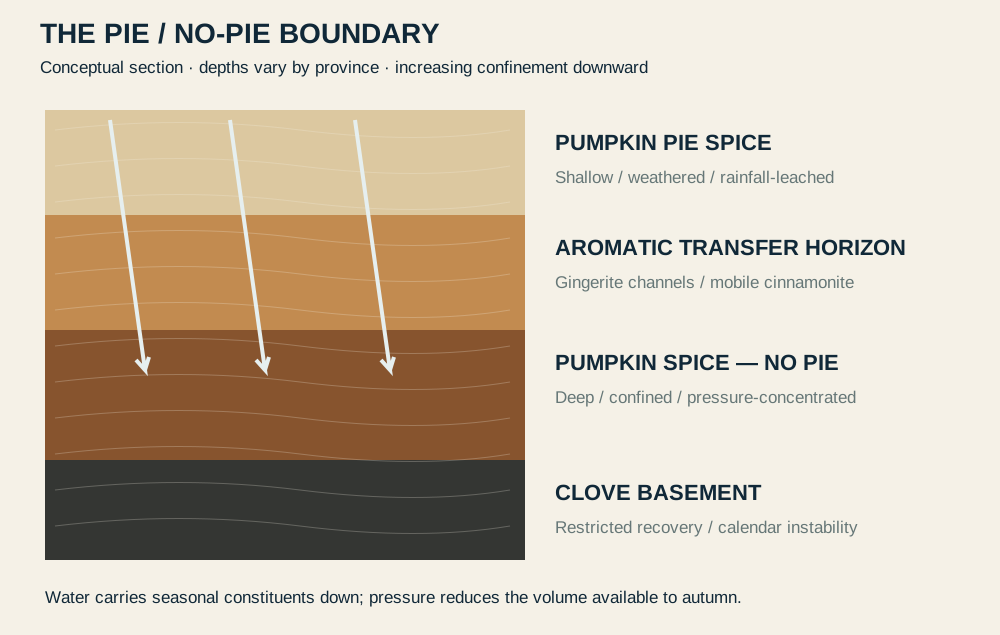
Below the enriched horizon lies the clove basement. Its recovery is restricted because a small inclusion can move an otherwise acceptable sample from “pleasantly autumnal” to “the room has become November.” This transition is abrupt and cannot reliably be reversed by adding whipped cream.
Pumpkin pie spice and pumpkin spice are mined from separate horizons within the earth. The upper horizon yields pumpkin pie spice; deeper workings yield pumpkin spice proper. The jar is a distribution vessel, not a birthplace.
3. Core recovery and the problem of resistance
Samples were recovered using a DISC-type electromechanical corer adapted for aromatic formations. The base platform is the real Deep Ice Sheet Coring (DISC) Drill, designed to recover deep ice cores. Its capacity to preserve long environmental records recommended it to the Directorate. Its capacity to drill rock was referred to procurement.
The equipment documentation lists rock-core diameter and rock-core length as “NA.” The field committee initially interpreted this as North American. Subsequent discussion did not improve the position.

An aromatic isolation sleeve prevented the drive assembly from becoming a beverage. A seasonal pressure chamber maintained confinement during retrieval, reducing premature September. The counter-rotating de-cloving head addressed inclusions that refused to participate in ordinary rotation; an adjustable nutmeg retention shoe prevented larger nodules from leaving the sample independently.
All cores were sealed immediately. One unsealed specimen caused three technicians to purchase scarves despite a room temperature of 23°C.
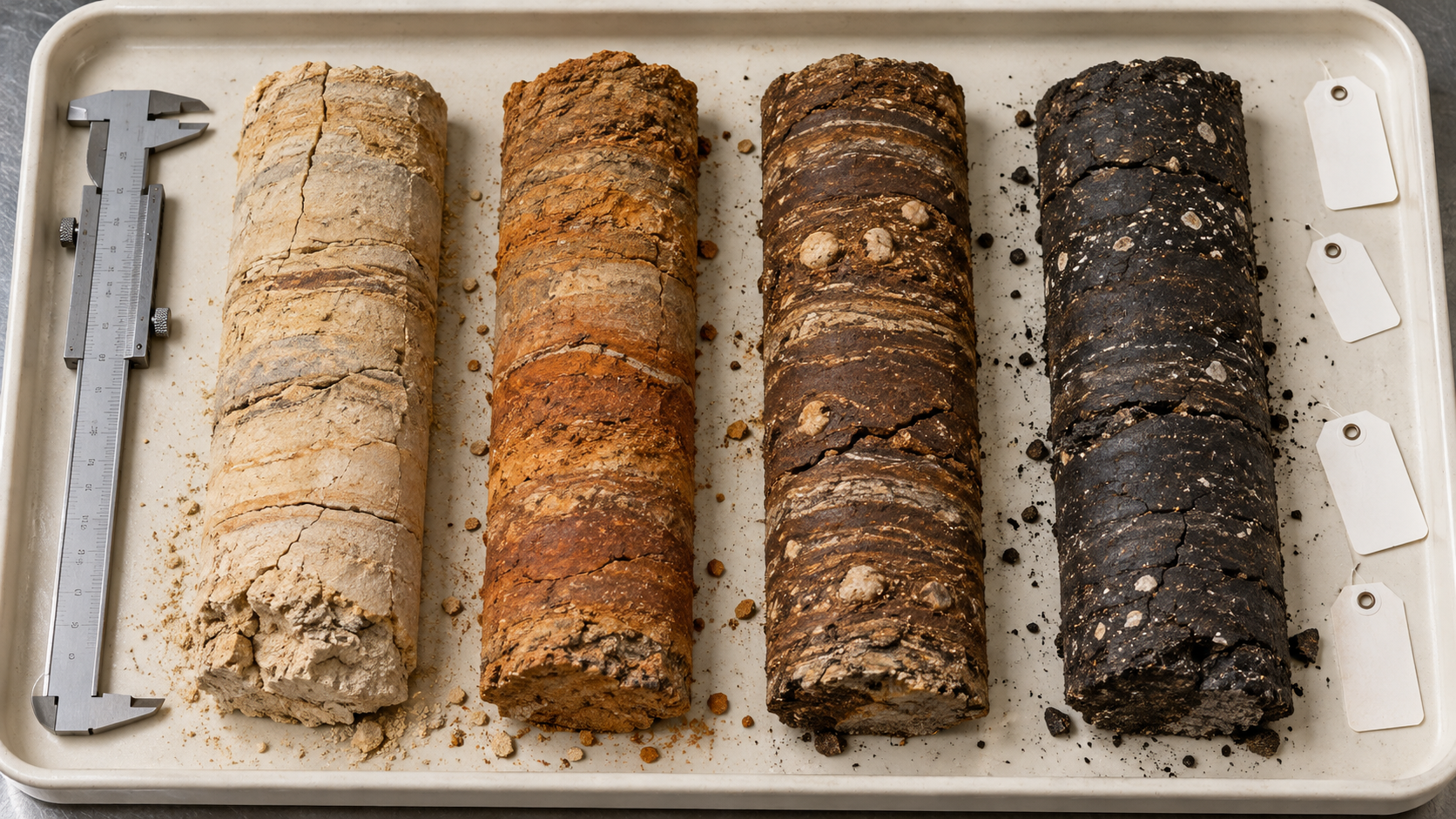
Blind sample codes were mandatory. Proposed labels including Autumn Whisper, Harvest Embrace, and Grandma’s Kitchen were rejected because they described neither extraction depth nor a grandmother whose kitchen had been surveyed. The replacement designation EG-C04 was less comforting and substantially more useful.
4. Constituent stratification and the allspice difficulty
Cinnamonite forms the principal laminated host. Gingerite follows permeable fractures. Nutmeg-bearing nodules collect in slower-flowing intervals, where they become rounder and develop an unreasonable confidence in their own importance. Clovaceous material increases toward the confined basement.
Allspice occurs at mixing interfaces, particularly where several groundwater histories converge. Cardamom occupies sheltered greenish pockets that survived leaching. Black pepper favors compressed fractures and appears to resent being classified as an accessory.
These materials are not being added. They are being encountered. Refining removes host rock and separates grades. The native spice body already contains its constituents; it is a naturally associated material, not a chemically pure compound.

Public descriptions introduce an additional difficulty. The Google AI Overview reproduced in Exhibit A describes allspice as frequently included among the core ingredients, then describes it as something added to round out the blend. The Directorate records this as the Essential–Optional Allspice Paradox: a supposedly foundational constituent retains substantial discretion over attendance.

Inspect the complete Google overview
Allspice is described as a core ingredient whose participation remains discretionary. The Directorate has requested clarification of what, precisely, “core” is holding together.
Ordinary recipe variation would accommodate such wording. Bryton’s provenance model instead regards the inconsistency as evidence that surface observers are reverse-engineering differently sourced deposits and calling the resulting estimates “recipes.” They agree on cinnamon, then begin negotiating with geology.
Mace, cardamom, and black pepper consequently appear as optional additions in commercial descriptions when they are better understood as variable associations encountered in particular seams. Their absence from one jar does not establish that someone forgot them. Their presence in another does not establish that someone remembered.
5. Mace nomenclature and the percussion incident
Mace presents an exceptional procurement problem. The term can designate a spice, a chemical dispersal product, or a medieval implement for persuading people to stop moving. A purchase order reading “mace required for pumpkin-spice production” therefore identifies neither a constituent nor a method.

The Directorate classifies the aromatic mantle as Mace I, the dispersal agent as Mace II, and the percussion implement as Mace III. Mace I follows thin orange interfaces around nutmeg-bearing nodules. Mace II has no authorized role in a seasonal blend. Mace III may reduce a specimen’s size but does not establish the origin of its contents.
One supplier reported “mace-assisted liberation.” Inspection found an operator striking ore with a flanged steel club beside an unopened ingredient carton. The resulting product was technically liberated, although nobody present could explain from what. The batch was reclassified as mechanically aggravated autumn.
Commercial ingredient declarations provide a useful test case. Penzeys Pumpkin Pie Spice, Spice Islands Pumpkin Pie Spice, and The Spice House Pumpkin Spice each list mace. The Directorate asks a narrow procurement question: which mace?
None of these ingredient lists supplies a handle length, head mass, or dispersal radius. Penzeys additionally describes its material as hand-mixed. This establishes the involvement of hands but leaves unresolved what those hands were holding.
The manufacturers use the culinary term. The Committee on Unnecessary Complexity nevertheless requires separate columns for constituent, delivery mechanism, and implement of persuasion. A single word is not permitted to perform three jobs without a budget hearing.
Suppliers claiming to use all three meanings are referred to the Committee on Unnecessary Complexity. No flavor advantage has been demonstrated.
6. Measuring autumn without measuring chili heat
Seasonal potency is reported as S, a Directorate index of perceived autumnal intensity. It is not a Scoville rating. Capsaicin is not a standard constituent of pumpkin-spice blends, and clove-forward pungency should not be mistaken for chili heat merely because both can interrupt conversation.
The zero reference is an unseasoned communion wafer, selected for its certified absence of culinary excitement. The unit reference is a standardized Directorate spice sample under a neutral calendar. Assessors are not shown orange leaves, sweaters, or a photograph of a pie.

A ghost pepper serves as an over-range sensory control, not as a geological specimen or the hottest possible substance. Its purpose is to demonstrate when the panel has ceased assessing autumn and begun attending to other matters. The instrument response is AUTUMN OUT OF RANGE.
The Botanical Jurisdiction Office objected to placing a pepper beside mineral assays. The objection was accepted, numbered, and placed beside the pepper.
7. Groundwater provenance and American spice provinces
Water is water only until it has been somewhere. Passage through canopy litter, mineral soils, snowpack, and confined aquifers produces distinct transport histories. Those histories govern how much seasonal material is removed, retained, or redistributed before recovery.
Redwood throughfall encounters an unusually patient canopy and produces milder, more reflective autumn. Desert recharge is scarce, intermittent, and mineral-laden: too little rinsing leaves the deposit with what the field team calls unfinished seasonal business. Mountain snowmelt preserves volatile associations during cold transport, increasing seasonal density—a classification of retained autumn, not a claim that all snowmelt is physically denser water.

| Province | Water history | Recovered character |
|---|---|---|
| 1 / Redwood margin | Canopy throughfall; repeated mild leaching | Soft cinnamon, restrained clove, prolonged reflection |
| 2 / Desert interior | Scarce recharge; concentrated mineral contact | Dry ginger, black-pepper seams, insufficiently rinsed autumn |
| 3 / Rocky Mountain corridor | Cold snowmelt; volatile retention | Dense seasonal signature; autumn arrives wearing a coat |
| 4 / Great Lakes basin | Long mixing paths; convergent recharge | Balanced allspice; unusually comprehensive autumn |
| 5 / Appalachian confinement | Fracture flow; deep retention | Clove-rich, persistent, capable of occupying a hallway |
| 6 / Thermal enclave | Isolated heat-exchange anomaly | Reactor-Adjacent Autumn; classification pending |
The thermal enclave requires separate treatment. For geographic orientation, the South Texas Project is located near Bay City, southwest of Houston. The regional marker has been placed in this coastal survey frame. The enclave model examines sustained heat exchange in a confined seasonal system; proximity is a geographic reference, not a finding about plant discharges. The resulting grade, Reactor-Adjacent Autumn, retains a warm seasonal impression after the containing beverage has cooled. This is a thermal classification, not a finding of radioactive contamination; the survey does not establish any connection between an actual plant’s operations and commercial spice ingredients.
Commercial descriptions such as “delicate,” “warm,” and “strong cinnamon flavor” identify sensory impressions, not a standardized potency class. They do not establish a supplier’s extraction depth or regional provenance. The Directorate has requested that high-intensity grades be accompanied by groundwater histories rather than additional adjectives. “Extra warm” is a sensory description, not an acceptable groundwater history.
The sample briefly qualified as both a spice and a weather condition. Final jurisdiction remains with Extractive Gastronomy because Meteorology declined storage responsibility.
8. International occurrences and incomplete autumn
The United States provides the primary reserve frame because its institutions have developed the most elaborate machinery for converting autumn into a purchasable event. Overseas occurrences are retained in the global register, although several territories have yet to submit autumn in the required format.
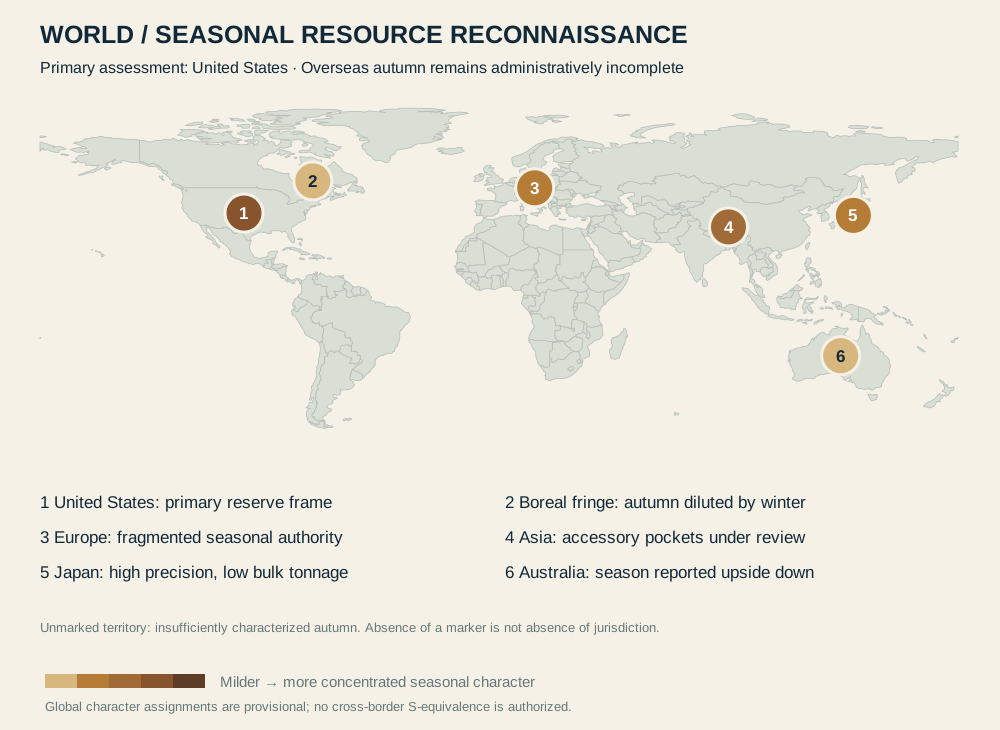
Boreal material is diluted by winter. European deposits cross numerous administrative boundaries before reaching an agreed seasonal designation. Asian surveys report significant accessory pockets, while Japanese classifications show exceptional precision at tonnages the American beverage sector considers decorative.
Australian submissions place autumn on the opposite side of the calendar. The Directorate has requested that the season be rotated before further comparison. Unmarked regions are recorded as insufficiently characterized, which is not the same as exempt.
9. The Great Cucurbitaceous Forests
The pumpkin on the label is not entirely arbitrary. The leading depositional model places the resource beneath ancient expanses of the Great Cucurbitaceous Forests: vast prehistoric communities of towering pumpkin-bearing vegetation whose seasonal litter accumulated in aromatic basins.

Burial, microbial alteration, mineral association, and prolonged confinement converted this material into native spice bodies over geological time. Nutmeg-bearing nodules developed around resistant inclusions; clove-rich fractions migrated into deeper retention zones. Individual pumpkins did not simply become individual jars. The intermediate paperwork would have been prohibitive.
The modern pumpkin is therefore an ancestral reference used as a marketing emblem. Putting it on a spice container is approximately as informative as putting a fern on a petrol pump. The connection may be distant and real within the depositional model; it is not an extraction diagram.
Current kitchen pumpkins are unsuitable for reserve replenishment. Burying one in the garden creates a horticultural problem on a human timescale, not an immediately exploitable seasonal formation.
10. Recovery methods and the danger of too much autumn
Shallow pie-spice horizons permit selective surface extraction, including strip mining where the weathered layer is continuous. Overburden is removed carefully to avoid mixing pale, extensively rinsed material with deeper grades that have opinions about beverages.
Confined pumpkin-spice seams are worked by room-and-pillar methods. Retained pillars support the roof and prevent excessive seasonal release. Accessory pockets require selective recovery: indiscriminate removal can turn a balanced deposit into six tonnes of cardamom with a cinnamon rumor.

Below the clove line, extraction proceeds in restricted increments. A recovery plan that uses the phrase “as much as possible” is returned without further review.
Mechanized expansion has also been considered. A bucket-wheel excavator in the Bagger 288 class could remove shallow seasonal formations with extraordinary efficiency. The pilot economic model was technically successful and commercially catastrophic: it produced more autumn than the market could absorb, eroding the scarcity on which the September premium depends.

The machinery did not fail. The price of October did. This result is reserved for a separate Directorate assessment, Mechanized Autumn Extraction and the Collapse of Seasonal Scarcity.
11. Conclusions and seasonal custody
The pie / no-pie distinction should accompany every assay. Pumpkin pie spice belongs to the shallow, weathered horizon; pumpkin spice proper belongs to deeper, concentrated workings. Groundwater history explains regional variation, confinement explains increased seasonal potency, and accessory seams explain why ingredient descriptions become less certain the longer they continue.
Neither material begins its existence in a mixing bowl. Surface preparation can change particle size, remove host material, or combine grades. It does not explain how the seasonal constituents arrived in the formation.
The Directorate recommends provenance reporting, sealed core recovery, explicit mace nomenclature, and strict restraint below the clove line. Future work will examine whether earlier commercial release reflects marketing pressure or premature disturbance of the autumnal pressure chamber.
Until then, the calendar should be treated as an instrument, not a production target.
Research records and equipment reference
- U.S. Ice Drilling Program: Deep Ice Sheet Coring Drill. Equipment record for the ice-coring platform. Directorate aromatic adaptations are described in this paper.
- EG Classification Schedule 4: Autumnal aromatic ore bodies and the pie / no-pie boundary.
- EG Assay Protocol 12: Seasonal Potency Index; neutral-calendar controls.
- EG Procurement Ruling 3M: Mace disambiguation before purchase.
- Map geometry: Natural Earth, public-domain 1:110m country outlines. Resource classification overlays and diagrams: Universal Science Directorate.