
ABSTRACT
We propose a primitive taxonomy of recreational competition based on decisive physical objects and competitive actions. Five core classes—Ball, Stick, Fight, Run, and Endure—are applied through an explicit precedence rule in which decisive elongated implements override balls. Secondary modifiers preserve distinctions such as accuracy, racing, and abstract opposition. A separate eligibility rule assigns competitions materially decided by aesthetic judgment to a performance register. Representative rulings resolve curling, chess, pole vault, and hammer throw while retaining an extended register for card, dice, tile, word, and electronic games.
1. The classification problem
Recreational classification has accumulated an unnecessary number of distinctions. Activities are separated by venue, season, social status, professional organization, and whether the participants have agreed to wear matching trousers. These distinctions describe the administration of recreation more reliably than its underlying structure.
A casino and a gymnasium may both contain a competition whose result depends on a ball. A golf course and an ice rink may both contain people manipulating an elongated implement. Calling one activity a casino game and another a winter sport does not explain what either participant is actually doing.
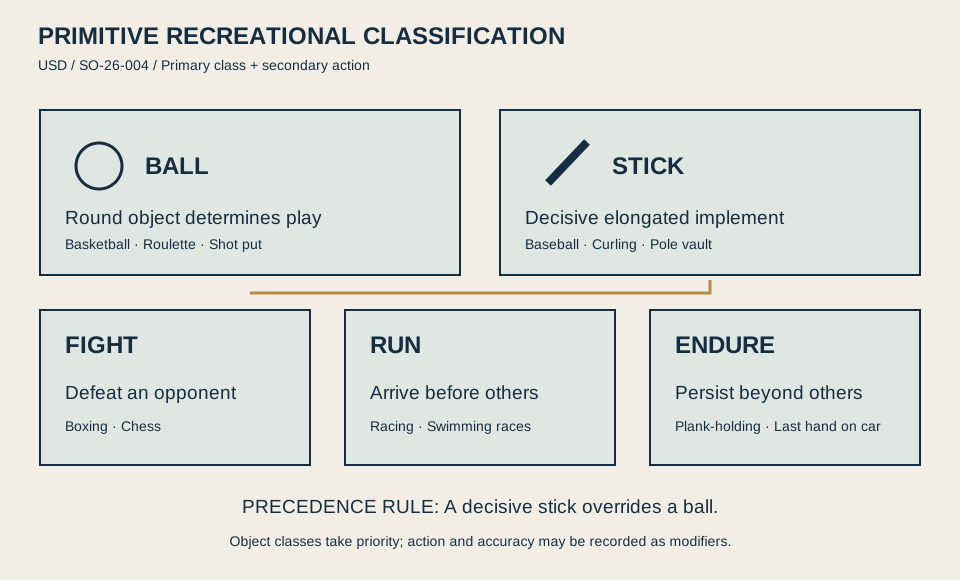
The Directorate adopts an operational alternative: identify the decisive object, then the competitive action. The resulting core framework consists of five primitive classes—Ball, Stick, Fight, Run, and Endure. It is intended to bring order to recreational activity with the smallest practical vocabulary and the least possible deference to existing committees.
2. The five primitive classes
Ball applies when a round object determines play and no decisive stick takes precedence. Basketball, bowling, bocce, shot put, and physical-ball roulette belong here. The diameter of the ball, the size of the audience, and the presence of a cashier do not change its classification.
Stick applies when an elongated implement materially defines the activity. Bats, clubs, rackets, cues, paddles, poles, and sufficiently elongated boards qualify. A racket is a stick with an enlarged contact assembly. A ski is a load-bearing foot stick. A surfboard is a broad aquatic stick on which the participant stands.
Fight applies to direct competitive opposition. Physical contact is optional. Boxing and wrestling are bodily variants; chess is an abstract variant conducted by people who have agreed to settle the matter without striking each other.
Run applies to a race in which arrival order or completion time determines the result. The term names the competitive action, not a required gait. Swimming races therefore qualify despite their notable shortage of running.
Endure applies when persistence under a condition determines the winner. Plank-holding and last-hand-on-the-car contests are representative. The participant’s fundamental proposition is that the condition will become intolerable to somebody else first.
3. Object precedence and secondary modifiers
The framework requires a precedence rule because many activities contain both a ball and a stick. Baseball, tennis, golf, and billiards cannot be allocated consistently by counting whichever object the observer noticed first. A decisive elongated implement takes priority over a ball. This is the Stick Precedence Principle.
“Decisive” excludes incidental equipment. A baton used only to indicate a relay exchange does not convert a footrace into a stick event. A cue used to direct billiard balls does. The test is whether the implement’s manipulation materially defines the ordinary mode of play.
Object classes receive primary status. Competitive action can then be recorded as a modifier. Curling is Stick + Fight + Accuracy. Rowing is Stick + Run. The addition of Run does not require the rower to leave the boat and jog alongside it.
Where no decisive object class applies, the winning condition determines the primary action class. A timed race is Run; a last-remaining contest is Endure; direct adversarial defeat is Fight. These rules prevent “everyone is trying to win” from reducing the entire framework to one enormous Fight department.
4. Classification register
| Activity | Primary class | Secondary description |
|---|---|---|
| Basketball | Ball | Direct opposition |
| Physical-ball roulette | Ball | Chance-mediated outcome |
| Shot put | Ball | Distance |
| Hammer throw | Ball | Tethered distance |
| Baseball | Stick | Ball-mediated opposition |
| Billiards | Stick | Ball-directed accuracy |
| Curling | Stick | Fight + Accuracy |
| Darts | Stick | Projectile accuracy |
| Archery | Stick | Projectile accuracy |
| Rowing | Stick | Run |
| Pole vault | Stick | Participant-launching height |
| Skiing / snowboarding | Stick | Foot-mounted locomotion |
| Barbell weightlifting | Stick | Load displacement |
| Caber toss | Stick | Large botanical implement |
| Chess | Fight | Abstract opposition |
| Footrace / swimming race | Run | Timed locomotion |
| Plank-holding contest | Endure | Persistence |
The register concerns physical-ball roulette and conventional equipment versions. A purely electronic representation need not inherit the physical classification of what it depicts. Likewise, a virtual golf club does not establish that the player is holding a stick. Implementation and represented activity should be recorded separately.
5. Resolution of contested cases
Curling. The stone initially drew attention toward an object-based accuracy classification. Subsequent review established that the broom-like implements materially influence play and therefore trigger Stick precedence. Curling is reinstated as a sport under the Directorate’s rules. Its classification is not suspended merely because the sticks resemble cleaning equipment.
Hammer throw. The implement presents a more serious nomenclatural problem: the thrown apparatus is a ball connected to a wire and handle. The wire is a flexible tether, not a decisive rigid stick. The event is therefore Ball, with a tethered-distance modifier. The word “hammer” remains an inherited name rather than a satisfactory equipment description.
Pole vault. The pole is used to launch the participant rather than another object. This reverses the familiar throwing relationship but does not alter the decisive implement. The person is the payload. Stick remains the primary class.
Caber toss. Increasing the dimensions of a stick until it resembles a tree does not create a new fundamental category. Botanical scale is a modifier. The Directorate declines to establish a separate division every time a Scottish participant locates a larger piece of wood.
6. Sport eligibility and aesthetic judgment
Classification and sport eligibility are separate questions. An activity can be recreationally classifiable without satisfying the Directorate’s definition of a sport. Solitaire remains a game. Roulette remains a ball game. Neither receives athletic status merely by joining a class that also contains basketball.
For this framework, sport eligibility requires an objectively specified competitive outcome. Time, distance, counted scores, successful lifts, and defined defeat conditions can satisfy that requirement. Rules may need officials to enforce them; that is different from making aesthetic preference a material part of the winning condition.
Competitions decided materially by presentation, artistry, style, or overall impression are assigned to the Performance Competition register. Ice dancing and artistic swimming therefore receive a different administrative classification. Their difficulty, conditioning demands, and participants’ athletic ability remain unaffected by the change.
The Directorate considers the distinction essential. “Who completed the task?” and “Who performed it most beautifully?” are different questions. Combining them has produced generations of sporting disputes in which several people with clipboards attempt to quantify majesty.
7. Equine classification ruling
Case study: competitive horse dancing
Dressage presents the Directorate with an unusually elaborate classification problem. A horse is capable of speed, strength, endurance, and carrying a person somewhere that person was not previously located. Competitive horse dancing instead asks whether the horse can move with sufficient elegance to satisfy several stationary people.
The competitive objective is neither arrival nor distance, neither a defeated opponent nor a heavier load. It is the production of approved horse movements. The rider supplies instructions. The horse supplies almost all the locomotion. A panel supplies numbers reflecting the extent to which the resulting horse activity resembles the horse activity the panel had hoped to see.
The Directorate assigns the following designation: Performance Competition / Equine / Delegated Locomotion / Aesthetic Adjudication. In abbreviated form: Competitive Horse Dancing. The presence of an exceptionally expensive animal does not create a sixth primitive category.
Attempts to classify the event as Run fail because nobody is required to arrive first. Endure is also unsuitable: the spectators’ patience is not an official scoring criterion. Fight would require the horse to be an opposing participant rather than the principal means of production. A riding crop does not establish Stick precedence when the winning condition remains an assessment of how beautifully the horse complied.
The central administrative difficulty is that the horse performs the movement while the human receives much of the professional credit. It is unclear whether the horse considers itself an athlete, an employee, a vehicle, or the unwilling artistic director of a project it did not commission. The Directorate’s Participant Attribution Office has requested the horse’s position. The rider has responded on its behalf, which has not resolved the question.
The working comparison with artistic swimming is therefore precise: both require substantial physical ability in the service of aesthetically judged movement. Horse dancing adds a second species and transfers the difficult part to it. Competitive ballroom dancing removes the horse, returning the structure to a wedding reception with administrative overhead.
Dressage remains in the Performance Competition register. The Directorate recognizes the skill and training involved but declines to accept “the horse looked magnificent” as a substitute for an objective sporting victory condition. Appeals must identify the winning action without using the words elegance, harmony, expression, or magnificent. No admissible appeal has been received.
8. Limits, extensions, and dress
The five-class core is deliberately coarse. The source framework also identifies card, dice, tile, piece, token, word, and electronic games. Those object and medium descriptors remain useful in an extended register rather than being forced into implausible stick or ball categories. Chess, for example, is Fight at the action level and a piece game at the equipment level.
Mixed events require mixed records. A strongman program containing stones, a log, and loaded carries does not acquire one primitive identity merely because the same exceptionally large person performs all three. Its components should be classified individually. Administrative convenience is not a scientific argument for pretending a stone is a stick.
The proposed No Pants amendment is recorded separately as a dress convention. Clothing does not determine primitive class. The amendment has been referred to Equipment Compatibility for review; fencing and ice hockey submissions remain unresolved. Removal of trousers cannot convert aesthetic judging into objective scoring.
9. Conclusions
The framework replaces inherited recreational boundaries with a concise account of objects and actions. It places roulette beside other ball games, recognizes chess as abstract fighting, and resolves mixed equipment through explicit stick precedence. It also distinguishes an activity’s classification from its eligibility under the Directorate’s sport definition.
The resulting system is broad enough to accommodate curling without apology and precise enough to reject the claim that a sporting hammer becomes a hammer solely because an established organization calls it one. Additional modifiers describe meaningful differences without multiplying fundamental classes.
The Directorate issues this taxonomy for use across recreational disciplines. Disagreement may be submitted with a complete description of the decisive object and winning condition. Existing tradition, audience size, and the claimant’s emotional attachment to a broom will not be accepted as substitutes.
10. Complete consolidated taxonomy
This register brings together the full inventory of games, sports, hybrids, amendments, and final rulings in the Directorate framework. The five primitive classes describe decisive objects or competitive actions; the extended register preserves the specific card, dice, tile, piece, token, word, and electronic distinctions. An activity can appear at more than one descriptive level without acquiring two contradictory primary rulings.
Apply decisive Stick precedence over Ball. Use the winning condition for action classes. Record accuracy and other meaningful features as modifiers. Assess sport eligibility separately.
BALL — Round object determines play
Basketball; football; rugby; soccer; bowling; bocce; pétanque; lawn bowls; shot put; water polo; handball; dodgeball; volleyball; four square; kickball; physical-ball keno; physical-ball bingo; physical-ball roulette; lottery ball drawings; pachinko; marbles; pinball; ball-in-cup; jacks played with a ball; hammer throw; Atlas stones.
The ball may be thrown, rolled, drawn, struck without a decisive stick, or tethered. Gambling status does not remove a physical ball from this class. Hammer throw is Ball with a tethered-distance modifier.
STICK — Decisive elongated implement
Baseball; golf; tennis; pickleball; badminton; hockey; lacrosse; cricket; polo; croquet; pool; billiards; snooker; rowing; javelin; pole vault; fencing; kendo; skiing; snowboarding; skateboarding; surfing; wakeboarding; paddleboarding; shuffleboard; air hockey; table hockey; mini golf; darts; archery; caber toss; curling; barbell weightlifting; powerlifting; Olympic weightlifting; log press.
A decisive stick overrides a ball or stone. Rackets are expanded-contact sticks; boards are broad or foot-mounted sticks. Darts are projectile sticks. Curling is primarily Stick, with Fight and Accuracy modifiers. A carried relay baton is incidental and does not invoke precedence.
FIGHT — Direct competitive opposition
Boxing; wrestling; mixed martial arts; arm wrestling; tug-of-war; chess; staring contests.
Physical contact is optional. Chess is abstract Fight. Stick or Ball remains the primary class where a decisive object already governs the activity: curling, darts, archery, shooting, bowling, and bocce may carry an adversarial or accuracy descriptor without erasing their equipment characteristics. Shooting requires a projectile/equipment descriptor in the extended register.
RUN — Arrival order or completion time
Footraces and other races without decisive Ball or Stick equipment; swimming races; loaded carries such as the farmer’s walk.
Run denotes the race structure, not a required gait. Rowing is Stick + Run. Timed board events remain Stick + Run. A farmer’s walk belongs here when completion time determines the result; a distance-to-exhaustion variant also receives Endure.
ENDURE — Persistence determines the result
Endurance sauna contests; static apnea / breath-holding; plank-holding; wall-sit contests; ice-bath endurance; standing contests; sleep-deprivation contests; chili-eating contests; competitive eating; last-hand-on-the-car contests; mechanical-bull contests.
Endure concerns remaining in a condition, rather than simply performing any strenuous task. Bull riding and bronc riding retain the source discussion’s mixed Fight / Endure treatment; they do not establish another primitive class. These are classification examples, not participation instructions.
Card games
Poker; blackjack; baccarat; bridge; hearts; spades; euchre; gin rummy; solitaire; Uno; Magic: The Gathering; Pokémon TCG; Cards Against Humanity.
Dice games
Craps; Yahtzee; Farkle; Bunco; Liar’s Dice; backgammon; dice-mediated Dungeons & Dragons.
Tile games
Mahjong; dominoes; Rummikub; Scrabble; Bananagrams.
Piece games
Chess; checkers; Go; Stratego; Risk; Monopoly; Sorry!; Clue; Settlers of Catan; Ticket to Ride.
Token, chip, and disc descriptors
Poker chips; roulette chips; casino-table stake markers; Connect Four; Othello / Reversi. Chips used for wagers are accounting equipment and do not change poker’s Card or physical roulette’s Ball classification.
Word, symbolic, and guessing games
Twenty Questions; charades; Wordle; Hangman; Boggle; crossword puzzles. Physical-object descriptors may be added: Scrabble is Tile + Word, and Boggle uses letter-bearing cubes.
Electronic implementations
Video games; arcade games; computer- and controller-mediated games. Record both actual interaction medium and represented activity. Physical pinball retains Ball as its primary class despite electronic scoring.
Other object descriptors
Cornhole: beanbag. Horseshoes: ring / horseshoe. Shooting: projectile and firearm. These descriptors remain visible rather than being forced into an unsupported ball or stick ruling.
Hybrids and disputed variants
- Monopoly: Piece, with Card and Dice components.
- Backgammon: Dice with Pieces.
- Chess: Fight at the action level; Piece at the equipment level.
- Curling: Stick + Fight + Accuracy. Reinstated; the final primary ruling is Stick.
- Darts: Stick + Fight + Accuracy.
- Archery: Stick + Accuracy, with Fight as an adversarial modifier where applicable.
- Bowling: Ball + Accuracy.
- Bocce: Ball + positional opposition / Accuracy.
- Rowing: Stick + Run.
- Pole vault: Stick; the participant is the launched payload.
- Hammer throw: Ball + tethered distance. No hammer category is recognized.
- Strongman: a mixed program. Atlas stones are Ball; log press is Stick; a timed farmer’s walk is Run with a load modifier. Truck pulling remains the source framework’s provisional “Fight against truck” case, subject to a winning-condition descriptor.
- Rodeo bronc riding and bull riding: provisional Fight + Endure treatment retained from the working discussion.
The sport-eligibility boundary
Objective winning conditions—time, distance, counted scores, knockout, pin, successful load, repetitions, or a defined last-remaining condition—qualify for consideration under this framework. Aesthetic judgment of how a participant looks or performs sends the event to the Performance Competition register, even where the participants are exceptionally athletic.
Performance Competition register: ice dancing; figure skating where artistry materially affects the outcome; rhythmic gymnastics; synchronized / artistic swimming; judged freestyle events where style materially affects the outcome; competitive dance; dressage; competitive ballroom dancing; competitive cheerleading where judged performance determines the result. This is the Directorate’s proposed eligibility rule, not a statement of official governing-body classifications.
The No Pants amendment
The recorded dress amendment calls for sports to be conducted without clothing. It is a separate administrative convention, not a sixth primitive category: Ball, Stick, Fight, Run, and Endure remain intact. The working register identifies obvious equipment conflicts in hockey, fencing, paintball, and cold-weather events. Clothing removal cannot rehabilitate a competition whose winning condition depends on aesthetic judgment.
Final constitutional rulings
- A decisive stick takes precedence over a ball, stone, or other manipulated object.
- “Fight” includes abstract opposition and does not require physical contact.
- “Run” describes racing and does not require running on foot.
- “Endure” closes the persistence gap in the four-class starting framework.
- Object descriptors and action descriptors can coexist.
- Athletic difficulty does not override the aesthetic-judgment exclusion.
- Curling is a Stick sport. Its reinstatement is final.
- A ball on a wire is not a hammer merely because the event name says so.
Research notes
- Strake, K. H. (2026). Primitive recreational classification: consolidated working register. Praxial Institute for Competitive Structures.
- SO Classification Schedule 1: Primitive objects and actions.
- SO Adjudication Notice 4: Curling reinstatement and stick precedence.
- SO Nomenclature Docket 7: The alleged hammer.